For most direct selling companies, the commission payout program sits firmly on the cost side of the ledger. You calculate commissions, send the batch, pay the provider, and move on to next month.
But every payout run also generates fees. Transfer fees, currency conversion, card loads, wallet fees. Someone collects that money every month, and in many payout programs it isn't you.
This article explains where those fees come from, who usually keeps them, and how a revenue-sharing model changes the economics of a program you are already running.
Your payout program is bigger than it looks
A distributor network of any real size produces a steady stream of financial activity. Every commission cycle means thousands of individual payouts across countries, currencies and payout methods. Many of those payouts carry a fee.
Some of the fees are visible to your finance team. Many are paid by the distributor, or are built into an exchange rate or a card program, so they never appear on your invoice. Taken together, they can add up to a meaningful amount every month, generated entirely by your network's activity.
Where payout fees come from
The exact mix depends on your program, but the common sources are:
- Transfer fees charged on bank transfers, wires and other payout rails
- Foreign exchange margins when a commission is converted into a distributor's local currency
- Card fees when distributors load commissions onto a debit or prepaid card
- Wallet fees, such as withdrawal or dormancy fees on balances held in an ewallet
- Alternative payout method fees for options like PayPal, Venmo or local wallets
None of these are unusual. They are a normal part of moving money. The question is what happens to them.
Who keeps them today?
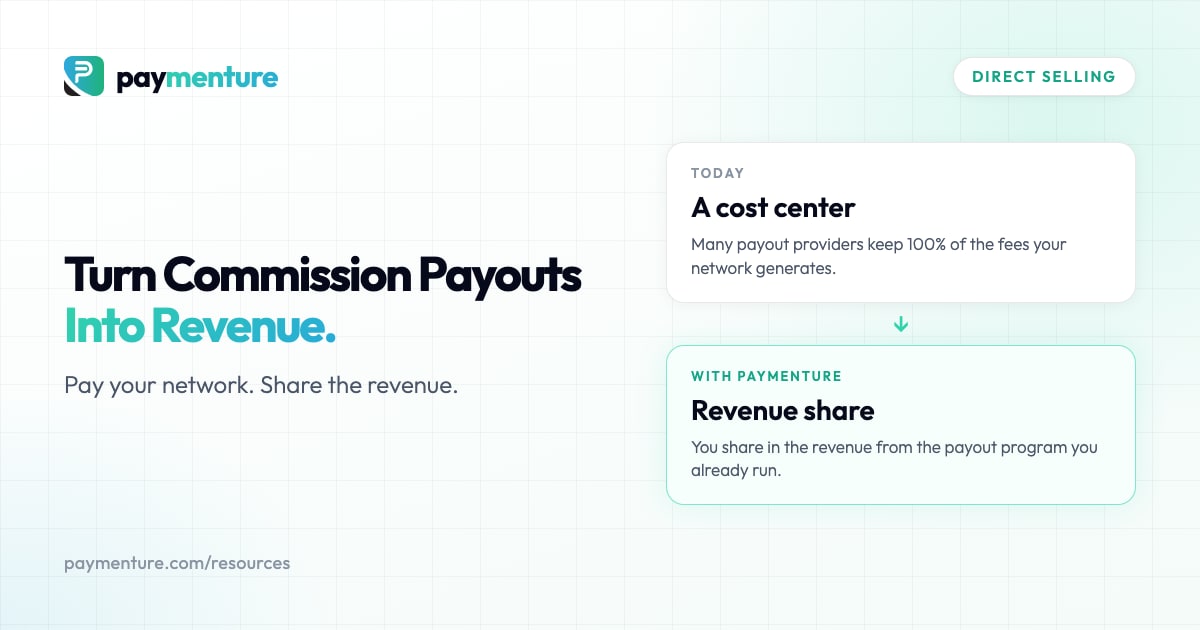
With many payout providers, the answer is simple: the provider keeps 100% of the fees. Your network generates the activity, and the provider captures all of the revenue that activity produces.
That arrangement is so common that most companies never question it. Commission payouts are treated as a pure operating expense, and the fee revenue is treated as the provider's business, not yours.
What a revenue-sharing model changes
Paymenture believes you should share in the revenue your payout program generates.
Under a revenue-sharing model, a portion of the fees generated by your network's payout activity comes back to your business. The program you already run, paying the same network on the same schedule, becomes a potential source of recurring revenue instead of only a cost.
Same network. Same payouts. A different business model behind them.
An illustrative example
To see how this can play out, consider a program that charges a monthly dormancy fee on inactive wallet balances. The figures below are illustrative only; actual fees and revenue share depend on your program and your agreement.
| Month | Fees charged | Your revenue share |
|---|---|---|
| Month 1 | $4,200 | $2,100 |
| Month 2 | $4,650 | $2,325 |
| Month 3 | $5,100 | $2,550 |
| Month 4 | $5,400 | $2,700 |
| 4-month total | $19,350 | $9,675 |
That is one fee type in one program. Across all of the fees a payout program generates, the shared revenue can become a recurring line item rather than a rounding error.
Revenue share shouldn't cost your distributors
A revenue-sharing model only works if it doesn't come at the expense of the people you pay. Your distributors still need:
- A choice in how they are paid, whether that is bank transfer, stablecoin, a funded card, autoship or methods like PayPal and Venmo. Available options vary by country and program.
- Reach into the markets they live in, including countries that traditional payout providers struggle to serve.
- Fast, predictable payouts, so commissions arrive when they expect them.
And your compliance team still needs KYC, AML and sanctions screening on every payout, along with W-9 and W-8 collection and 1099 filing for US distributors. Revenue share should sit on top of a payout program that already does all of this well.
Five questions to ask your payout provider
If you have never looked closely at the economics of your payout program, these questions are a good place to start:
- What fees does our program generate each month, including fees paid by distributors and fees built into exchange rates?
- Who keeps those fees today?
- Do you offer a revenue-sharing model, and how is the share calculated?
- Will revenue share change what our distributors pay or the payout options they can choose?
- Can we see reporting on the fees generated and the revenue shared, every month?
If the answer to the second question is "we keep all of it," it is worth a conversation about what your payout program could be earning.
The bottom line
Commission payouts will always be one of the most important things a direct selling company does. They don't have to be only a cost. A revenue-sharing model lets the activity your network already generates work for your business, without asking your distributors to give anything up.
Curious what revenue share could look like for your program? Request a demo and tell us your monthly payout volume. We'll walk you through the numbers.