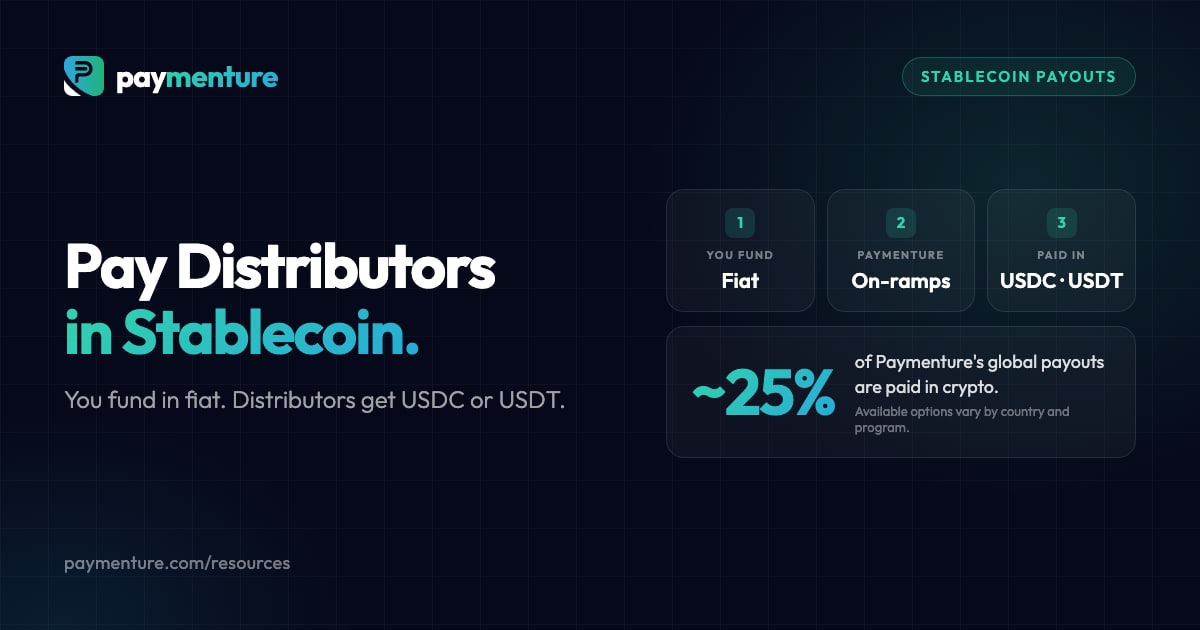
Crypto is no longer a niche payout option. About 25% of the payouts Paymenture sends globally go out in crypto, and for many direct selling companies, stablecoin is now one of the most requested ways to pay distributors outside the United States.
This guide covers why distributors ask for it, how a stablecoin payout actually works when your company only deals in fiat, and what to think through before you offer it.
Why distributors ask for stablecoin
For a distributor in the US or Western Europe, a bank deposit in their own currency is usually the simplest option. For a distributor in a country where the local currency is unpredictable, the picture is different.
When a currency loses value or swings from month to month, a commission can be worth noticeably less by the time it is spent. Distributors in those markets don't just want to get paid. They want their earnings to hold their value.
There are practical reasons too:
- Bank access. Some distributors don't have reliable access to a bank account that can receive international payments.
- Speed. A cross-border wire can take days to arrive. A stablecoin payout typically settles much faster.
- Cost. International wires and currency conversion can take a real share of a smaller commission. Stablecoin payouts typically cost less.
What a stablecoin payout is
Stablecoins such as USDC and USDT are digital assets pegged to the US dollar. They are designed to hold a steady value of one dollar each, which is what makes them useful for payouts: a distributor receives a dollar-denominated balance without needing a US bank account.
Once they are paid, distributors can choose what to do with it:
- Hold it, keeping their earnings in a dollar-pegged asset
- Cash out to their local currency
- Spend it using a card
It is worth being clear about what stablecoins are not. They are not bank deposits, and a peg is a design goal rather than a guarantee. Your distributors should understand the asset they are choosing, which is one reason stablecoin works best as one option among several rather than the only way to get paid.
How it works when you fund in fiat
You don't need to hold crypto to offer stablecoin payouts. With Paymenture, you fund commissions in fiat and the conversion happens on our side:
- You fund commissions in fiat, the same way you do today.
- Paymenture on-ramps those funds to stablecoin, with KYC, AML and sanctions screening built in.
- Distributors receive USDC or USDT in their wallet.
- They hold it, cash out or spend it, converting to local currency or spending with a card.
Your finance team keeps funding payouts in dollars. Nothing about your treasury, your accounting currency or your commission engine has to change.
One option among many
Stablecoin works best when distributors choose it, not when it is forced on them. In the same payout program, other distributors may prefer a bank transfer, a funded debit card, putting commissions toward product orders and autoship, or methods like PayPal and Venmo. Available options vary by country and program.
Talk Fusion is a good example. It pays its distributors in stablecoin through Paymenture as one of several options distributors can choose from, all from a single integration.
What to plan for before you launch
Offering stablecoin payouts is straightforward with the right provider, but a few things deserve attention up front.
Compliance
Every stablecoin payout should go through the same identity verification, AML checks and sanctions screening as any other payout. Make sure your provider screens every payout, not just onboarding, and keeps a clear record of who was paid, when and how.
Which markets and assets
Not every asset or payout option is available in every country. Confirm which markets your provider can serve with stablecoin, and which assets are supported, before you announce anything to your field.
Distributor communication
Explain the option clearly: what a stablecoin is, how to receive it, how to cash out or spend it, and the risks. Distributors who understand the choice are far more likely to be happy with it.
Tax reporting
A commission is still a commission, whatever form it is paid in. Your tax obligations, including W-9 and W-8 collection and 1099 filing for US distributors, don't go away because the payout method changed. Choose a provider that handles tax reporting across every payout method.
Questions to ask a payout provider
- Do you support stablecoin payouts, and which assets (for example USDC and USDT)?
- Can we fund in fiat and let you handle the conversion?
- Which countries can receive stablecoin payouts?
- Is KYC, AML and sanctions screening applied to every payout?
- Can distributors choose stablecoin alongside bank transfer, card and other methods?
- How do you handle tax forms and reporting for crypto payouts?
The bottom line
For distributors in markets with unstable currencies or limited bank access, a dollar-pegged stablecoin payout can be the difference between a commission that holds its value and one that shrinks before it is spent. Offered as a choice, with compliance built in and funding kept in fiat, it is one of the most practical ways to serve a global network.
Want to know which markets and assets we support? Request a demo and we'll show you how stablecoin payouts would work for your network.