Commission day is the day your distributors find out what your company really thinks of them. If the money arrives on time, in a form they can use, at a fair cost, they stay and keep building. If it's late, eaten by fees, or stuck in a bank that won't take it, they start looking elsewhere.
That's why choosing an MLM payout provider is one of the biggest decisions a direct selling finance team makes. It affects distributor retention, your cost per payout, your compliance exposure, and how quickly you can open a new market.
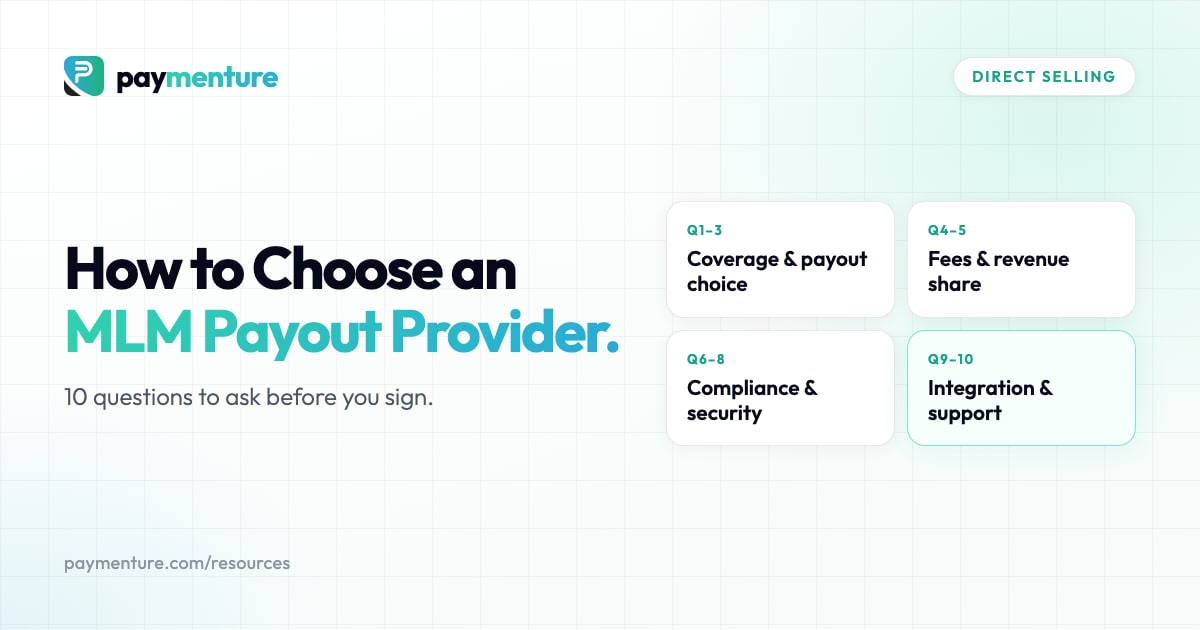
Most providers look alike on a sales call. The differences show up in the details. Here are 10 questions to ask before you sign.
Coverage and payout choice
1. Can you pay every distributor, in every market we sell in?
Start with the map. List every country where you have distributors today and every country you plan to enter in the next two years. Then ask the provider to confirm coverage country by country, not just "global."
Paymenture pays out to 200 countries in 145+ currencies, covering every country not restricted by OFAC sanctions. Hold any provider to the same standard, and ask specifically about harder-to-reach markets in Africa, Latin America and Southeast Asia, where many direct selling companies are growing fastest.
2. How can distributors receive their money?
A distributor in Ohio and a distributor in Lagos don't want the same thing. Ask which payout methods are supported: local bank transfer, mobile wallet, prepaid card, and stablecoin.
Stablecoin (such as USDC or USDT) matters more than many finance teams expect. In countries with unstable local currencies, distributors want earnings that hold their value. A dollar-pegged stablecoin is designed to hold a steady value, which makes it attractive to distributors who have watched their local currency lose ground. The best providers let each distributor choose their own method, rather than forcing one option on everyone.
3. How fast do payouts arrive?
Ask whether the provider supports instant, daily and scheduled payouts, and what "instant" actually means in each market. Faster access to earnings is a recruiting and retention tool. If a competitor's distributors get paid the same day and yours wait a week, your field will notice.
Fees and economics
4. Who pays the fees, and what are they?
Get a complete fee schedule: per-transaction fees, FX spreads, withdrawal fees, P2P transfer fees and any monthly minimums. Then ask who pays each one, the company or the distributor. Hidden FX spreads are the most common surprise, so ask for the spread on your top five currencies in writing.
5. Does any of that fee revenue come back to us?
Most payout providers treat your payout volume purely as a cost center. It doesn't have to be. Ask whether the provider shares revenue with you.
With Paymenture, payout fees can become a revenue line instead of only an expense. Dormancy fees, for example, are disclosed up front, charged to the payee only after 90 days of inactivity, and shared 50/50 between Paymenture and the client company. If a provider charges fees on your distributors' accounts, you should know exactly what they are and whether you share in them.
Compliance and security
6. How do you handle KYC, AML and sanctions screening?
Your payout provider is part of your compliance program, whether you planned it that way or not. Ask whether KYC (know your customer), AML (anti-money laundering) and sanctions screening are built into onboarding and every payout, or whether they're bolted on and left for your team to manage.
7. What happens at tax time?
Ask how the provider collects W-9 and W-8 forms, whether it supports 1099 reporting for US distributors, and how it handles international payees. Tax collection done at onboarding is far easier than chasing thousands of distributors in January.
8. How do you protect funds and payout data?
Ask about security controls, access permissions and audit trails. Can you see who approved each payout batch and when? Paymenture records payout activity in a tamper-evident, auditable trail, so your finance and compliance teams can trace any payment from approval to delivery.
Integration and experience
9. How does it connect to our commission engine and back office?
The best payout provider in the world is useless if your team has to move CSV files around every week. Ask whether the provider has a single API, whether it already integrates with your commission engine, and whether it can be white-labeled or embedded in your distributor back office so the experience carries your brand.
Viago, for example, runs Paymenture payouts through its Teqtank integration, so commissions flow straight from calculation to payment.
10. What does support look like for us and for our distributors?
When a distributor's payout fails at 9pm on a Friday, who answers? Ask about support hours, languages, escalation paths and whether the provider supports your field directly or routes everything back to your team. Ask for references from direct selling companies of similar size.
Your checklist
Before you sign with an MLM payout provider, make sure you can answer yes to each of these:
- Covers every country we sell in today and plan to enter
- Lets each distributor choose bank, wallet, card or stablecoin
- Supports instant, daily and scheduled payouts
- Provides a complete, written fee schedule, including FX spreads
- Shares fee revenue with us, with fully disclosed terms
- Builds in KYC, AML and sanctions screening
- Collects tax forms and supports 1099 reporting
- Keeps a tamper-evident, auditable record of every payout
- Integrates with our commission engine through one API, with white-label options
- Offers responsive support for our team and our distributors
See how Paymenture answers all 10
Paymenture is built for direct selling companies that pay a global field. We pay out to 200 countries in 145+ currencies, in fiat or stablecoin, with compliance built in and a revenue share that turns payouts into income.
Book a demo and we'll walk through your markets, your current fee costs, and what your payouts could look like with Paymenture.