In short: If you pay distributors, affiliates or contractors, the 1099 deadline at the end of January is closer than it looks. The work that makes January painless happens now: collecting tax forms, cleaning payee data and knowing which payees need a form at all.
Why it matters: Missing or wrong forms mean IRS penalties, backup withholding problems and a flood of "Where's my 1099?" tickets from your field. Most of it is avoidable if you start in Q4.
This article is general information, not tax advice. Talk to your tax advisor about your specific situation.
What changed for 2026
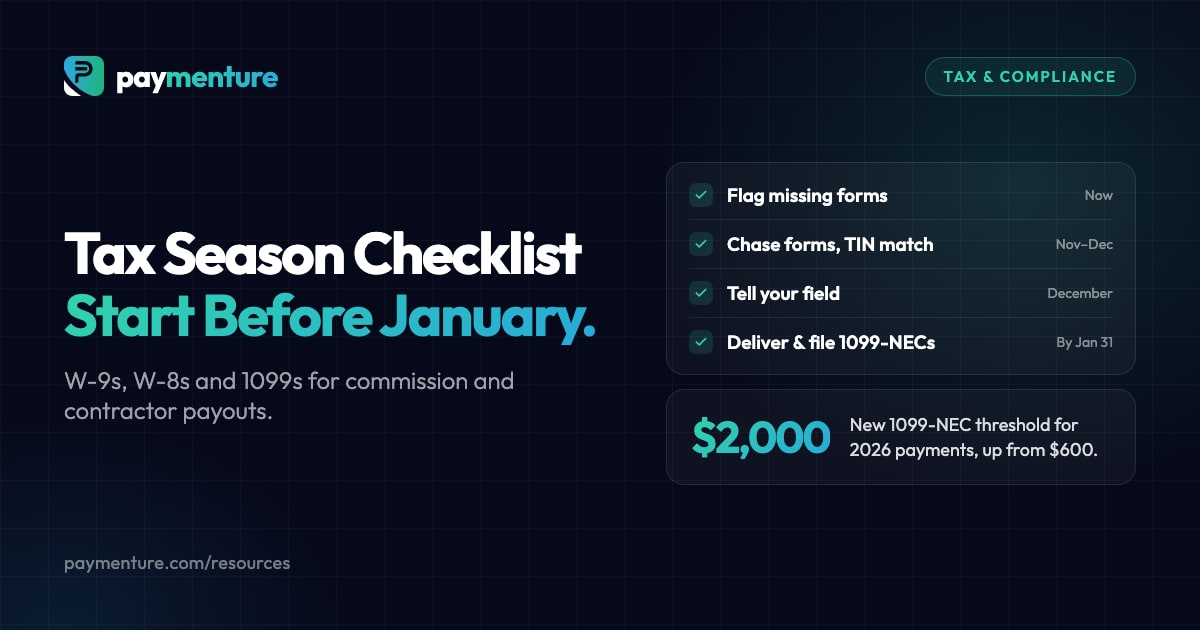
The biggest change this year: under the One Big Beautiful Bill Act, the reporting threshold for Form 1099-NEC and 1099-MISC rises from $600 to $2,000 for payments made in 2026. After 2026 it's indexed for inflation.
That means fewer forms for many companies. It doesn't mean less work. You still need accurate payee records for everyone, because you don't know in advance who will cross $2,000 by December 31, and your systems need to apply the new threshold correctly.
One rule that matters for direct selling hasn't changed: if you sold $5,000 or more of consumer products to a payee for resale, you report that on Form 1099-NEC (box 2), even if no commission was paid.
The checklist
1. Know who gets which form
- U.S. payees (people and most businesses): collect a Form W-9. If you paid them $2,000 or more in 2026 for services, they get a 1099-NEC.
- Non-U.S. individuals: collect a Form W-8BEN.
- Non-U.S. entities: collect a Form W-8BEN-E.
Payments to foreign persons for work done entirely outside the U.S. are generally not U.S.-source income, so they usually don't need a 1099. A valid W-8 on file is how you document that. Without it, you may be expected to treat the payee as a U.S. person.
2. Find the gaps now
Pull a list of every payee you've paid this year and flag:
- Payees with no tax form on file
- U.S. payees with missing or invalid TINs
- Payees whose name doesn't match their TIN
- Expired W-8s (a W-8BEN is generally valid through the end of the third calendar year after it's signed)
- Payees who moved countries during the year
Every flag you fix in November is a corrected form you don't file in March.
3. Run TIN matching
The IRS offers a TIN Matching program for payers. Use it on U.S. payees before you file. A name/TIN mismatch can trigger a CP2100 notice later and force you to start backup withholding.
4. Get forms at the source, not in January
The cleanest fix is structural: collect the right tax form during onboarding, before the first payout. A payee who can't get paid until their W-9 or W-8 is complete is a payee you'll never have to chase.
Paymenture collects W-9 and W-8 forms at signup, as part of the same onboarding flow as KYC. Finance starts tax season with a complete file instead of a to-do list.
5. Reconcile totals across every payout method
If you pay through several providers (a bank provider here, a card program there, a separate crypto vendor), each one has a piece of each payee's annual total. Adding them up by hand is where errors creep in.
Make sure your year-end totals include every payout method and every currency. Stablecoin payouts and card loads count as payments too.
6. Plan your filing method and dates
- 1099-NEC: due to recipients and the IRS by January 31 (or the next business day when it falls on a weekend).
- 1099-MISC: due to recipients by January 31. The IRS deadline is later, especially if you e-file.
- E-filing: required if you file 10 or more information returns in total.
Decide now whether you'll file yourself or have your payout provider do it. Paymenture can file 1099s with the IRS on your behalf and deliver copies to payees.
7. Warn your field before they ask
Send a short note in December: when forms will arrive, how to get them (email, back office or mail), and how to update their tax info before the deadline. One email in December saves hundreds of support tickets in February.
A simple timeline
| When | What to do |
|---|---|
| Now – mid-November | Pull your payee list and flag missing or invalid forms |
| Mid-November – December | Chase missing forms, run TIN matching, fix name mismatches |
| December | Tell your field what's coming and when |
| Early January | Lock year-end totals across all payout methods |
| By January 31 | Deliver 1099-NECs to payees and file with the IRS |
How Paymenture helps
- Tax forms at onboarding. W-9 and W-8 collection is built into signup, alongside KYC/AML and sanctions screening.
- One record per payee. Bank, card, stablecoin and wallet payouts all sit on one ledger, so year-end totals come from one place.
- 1099 filing handled. Paymenture can file with the IRS on your behalf and deliver copies to payees.
- A tamper-evident audit trail. Every payout is recorded on our blockchain dual ledger, which gives finance and auditors a clear history. More in Payout Security: Why We Built Paymenture on Blockchain.
Start before January
The companies that have a calm January are the ones that fixed their data in November. If tax season is already on your mind, book a 20-minute demo and we'll show you how onboarding, payouts and 1099s fit together in one flow.