Every commission run moves real money to thousands of people in dozens of countries. That makes your payout system one of the most attractive targets in your business for hackers, fraudsters and even insiders. It's where the money leaves the building, often in large, frequent batches to accounts all over the world.
Most finance teams don't think about payout security until something goes wrong: a distributor's bank details are changed without their knowledge, a payment is sent twice, or a payee insists they were never paid and nobody can prove otherwise. By then, you're reconstructing what happened from spreadsheets and support tickets.
We built Paymenture so that question always has a clear answer. Here's how, and why blockchain is part of it.
The real risks in commission payouts
Payout fraud rarely looks like a movie heist. It usually looks like ordinary activity:
- Account takeover. Someone gains access to a distributor's account and changes where the money goes.
- Altered records. A payout amount, recipient or approval is changed after the fact, accidentally or on purpose.
- Duplicate or misdirected payments. A batch is sent twice, or to the wrong account, and nobody notices until reconciliation.
- Sanctions and identity exposure. A payout goes to someone who should never have been paid at all.
- Disputes with no proof. A payee says "I never received it," and your records can't settle the question.
What these have in common is trust in the record. If you can't be sure your payout history is accurate and complete, you can't catch fraud, settle disputes or satisfy an auditor.
What blockchain adds: a tamper-evident record
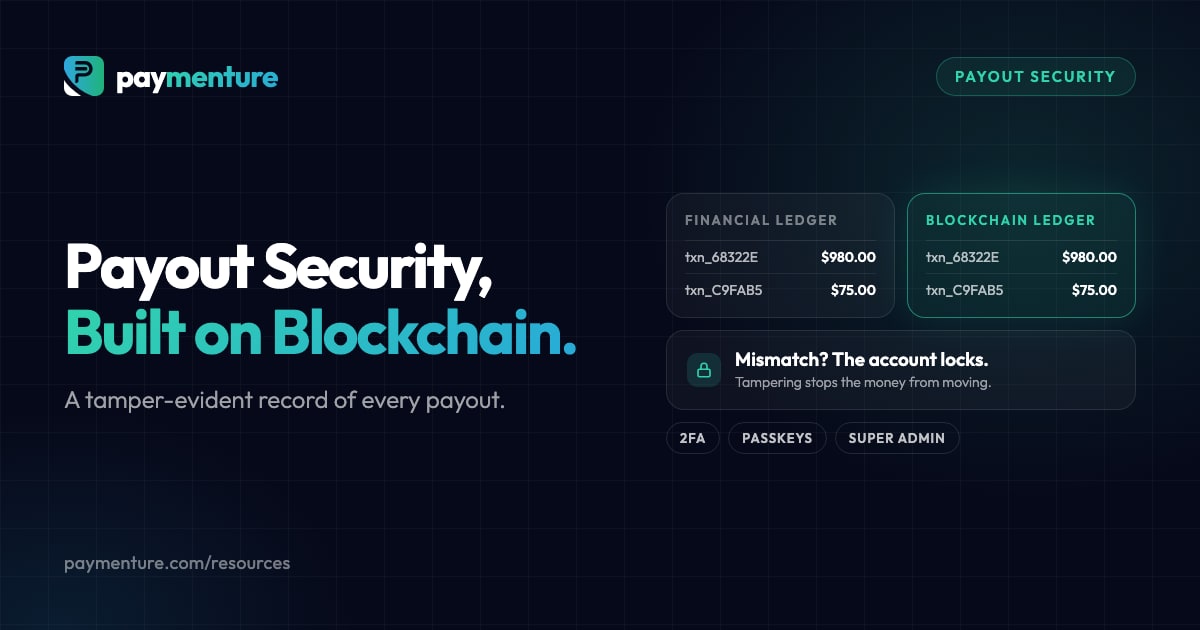
Paymenture runs on a dual ledger. Payouts are processed on a traditional financial ledger, the kind every payments company uses, and each payout is also recorded on a blockchain-based ledger.
The value of that second record comes from how blockchains work. Each new entry is cryptographically linked to the entries before it. If anyone tries to change a past record, those links no longer match, and the change becomes detectable. That's what makes the record tamper-evident: changes don't go unnoticed.
If the ledgers don't match, the account locks
The two ledgers are constantly checked against each other. If someone tampers with a record in the traditional financial ledger, whether an outside attacker or someone with inside access, it will no longer match the blockchain ledger.
When that happens, Paymenture automatically locks the affected account. No transactions can take place on it, so money can't be moved out on the strength of an altered balance or a changed payout record. The rest of your payouts keep running, while the locked account is investigated.
In other words, tampering doesn't just leave evidence. It stops the money.
In practice, the dual ledger gives your team:
- An auditable trail for every payout. You can trace a payment from the moment it was created to the moment it was delivered.
- Automatic protection against altered records. A mismatch between the ledgers locks the account before any money moves.
- Proof in disputes. When a distributor says they weren't paid, you have a verifiable record of what was sent, when and to which account.
- Easier audits. Finance and compliance teams get one consistent history instead of piecing together exports from several banks.
What blockchain doesn't do on its own
We're careful not to oversell the technology. Blockchain doesn't stop a fraudster from logging in with stolen credentials, and it doesn't decide who should be paid. A tamper-evident record is only as useful as the controls around it.
That's why it's one layer of Paymenture's security, not the whole story. We use blockchain as proof of trust, alongside the controls below.
Controls that stop bad payouts before they happen
Two-factor authentication whenever money moves
A stolen password shouldn't be enough to move money. On Paymenture, two-factor authentication (2FA) is required any time real money moves.
2FA means proving who you are in two ways: something you know, like your password, and something you have, like a one-time code sent to your phone or generated by an authenticator app. Even if a hacker gets hold of a password through phishing or a data breach, they can't complete a money movement without that second factor.
That closes off one of the most common routes to payout fraud: account takeover. It's the safeguard that handles what the blockchain record can't.
Passkeys: protection against phishing
Paymenture also uses passkeys, a newer way to sign in that replaces typed passwords with your device. Instead of entering a password, you confirm it's you with your fingerprint, face or device PIN.
Behind the scenes, a passkey uses a pair of cryptographic keys. The private key stays on your device and is never shared, and each passkey only works with the site it was created for. That means there's no password for a hacker to steal in a data breach, and nothing a fake login page can trick you into handing over. Phishing, one of the most common ways attackers get into financial accounts, becomes far harder.
Only Super Admins can move corporate money
On the corporate side, not everyone on your team needs the power to send money, so not everyone has it. Only users with the Super Admin role can move money from your company's account.
Other team members can still get access for their own work, but they can't move corporate funds. That limits the number of people who could be tricked, pressured or compromised into sending money, and it makes accountability clear. When corporate money moves, you know it was a Super Admin, verified with 2FA, and the transaction is recorded in the tamper-evident trail.
Together, these controls do the preventing, and the blockchain-backed record does the proving.
Questions to ask any payout provider about security
Whether or not you work with us, these questions are worth asking:
- If a payout record in your ledger were changed, how would we know, and what would stop money from moving?
- Can we trace any single payment from creation to delivery?
- Is two-factor authentication required every time money moves, and do you support passkeys?
- Can we limit who on our team is able to move money?
- Are KYC, AML and sanctions screening built in, or are they our responsibility?
- How do you handle disputes when a payee says they weren't paid?
- Do crypto or stablecoin payouts get the same controls as bank payouts?
- What records can you give our auditors, and how quickly?
If the answers are vague, your payout history may be harder to defend than you think. For more questions, see our guide on how to choose an MLM payout provider.
Security you can prove
For direct selling companies, security is about more than preventing fraud. It's about being able to show your distributors, your auditors and your regulators exactly what happened with every dollar you paid out.
That's why we built Paymenture on a blockchain-backed dual ledger: so every payout leaves a tamper-evident, auditable trail, with compliance built in from the start.
Book a demo and we'll show you how a payout is recorded, traced and audited on Paymenture.